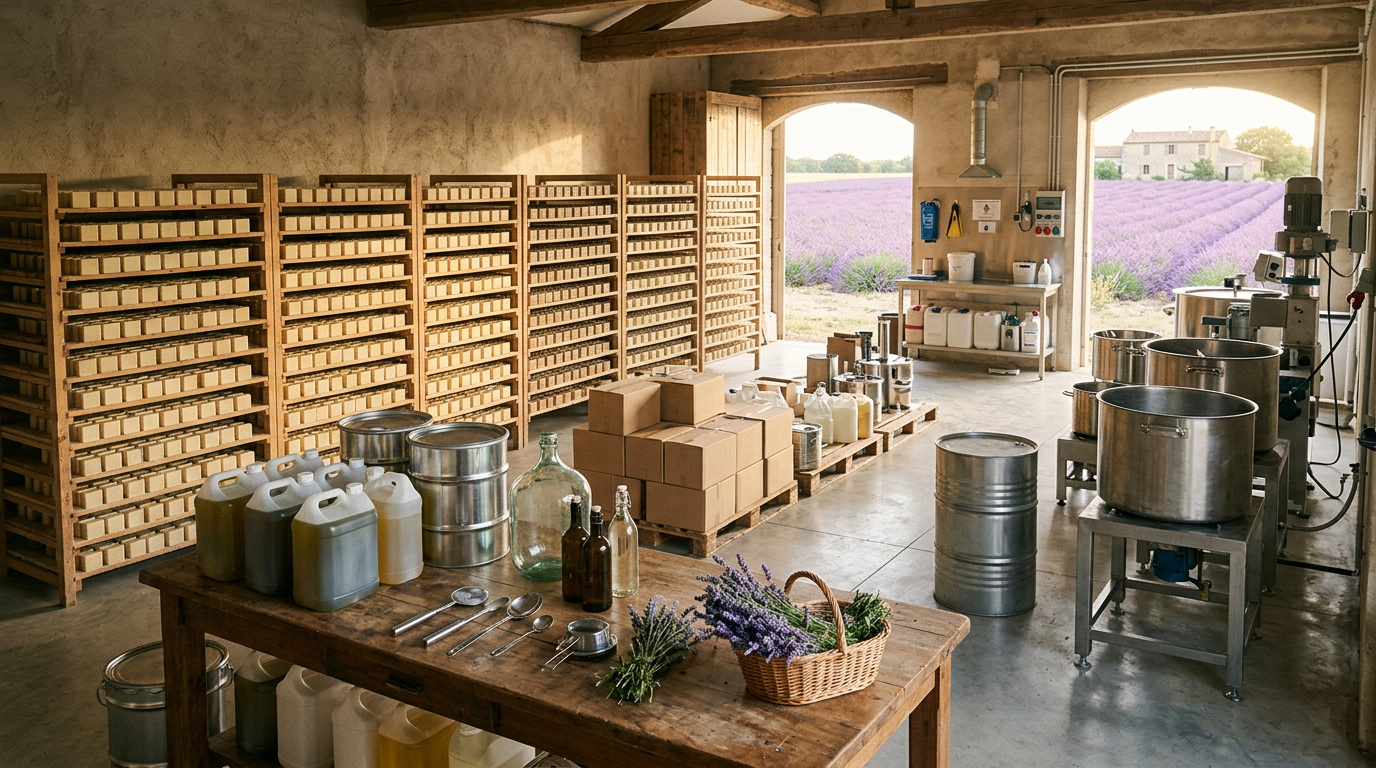
Soap makers need an oil that keeps its floral character through an alkaline cook and a weeks-long cure, which is a harder test than a candle pour or a lotion base. This page is part of our Guide to Buying Lavender Essential Oil in Bulk.
Test a lot through a full cure before scaling to production.
Cold-process and melt-and-pour methods both call for an oil that can survive the saponification chemistry without the aroma collapsing into something flat; the full method comparison is in a guide to cold-process and melt-and-pour lavender soap.
One soap studio's working notes on batching true lavender at production scale, including how the scent held up after cure, are documented in a soap studio's cold-process batch notes on true lavender oil, a useful reference for a first wholesale order.
Because lye and cure time both work against fragrance retention, soap makers tend to formulate on the higher end of a safe usage range compared with a leave-on cosmetic, and to bench test a full cure cycle rather than judging scent strength at trace.
Batch-to-batch consistency matters more here than in almost any other category, since a soap maker cannot easily correct a weak-smelling bar after a long cure; species and grade consistency are covered in a guide to lavender varieties and quality.
Always run a full cure cycle on a new lot before scaling to a production batch; a scent that reads strong at trace can fade unevenly by the time the bars are ready to sell, and the only way to catch that is to wait out the cure.
A soap studio testing a new recipe usually starts with a 1 oz sample for the first few bars, then moves to 5 lbs and 25 lbs once the cured bars pass muster; see a guide to which lavender oil size to order first for that progression.
Start at 1 oz for a bench batch, scale to 25 lbs once cured bars pass.